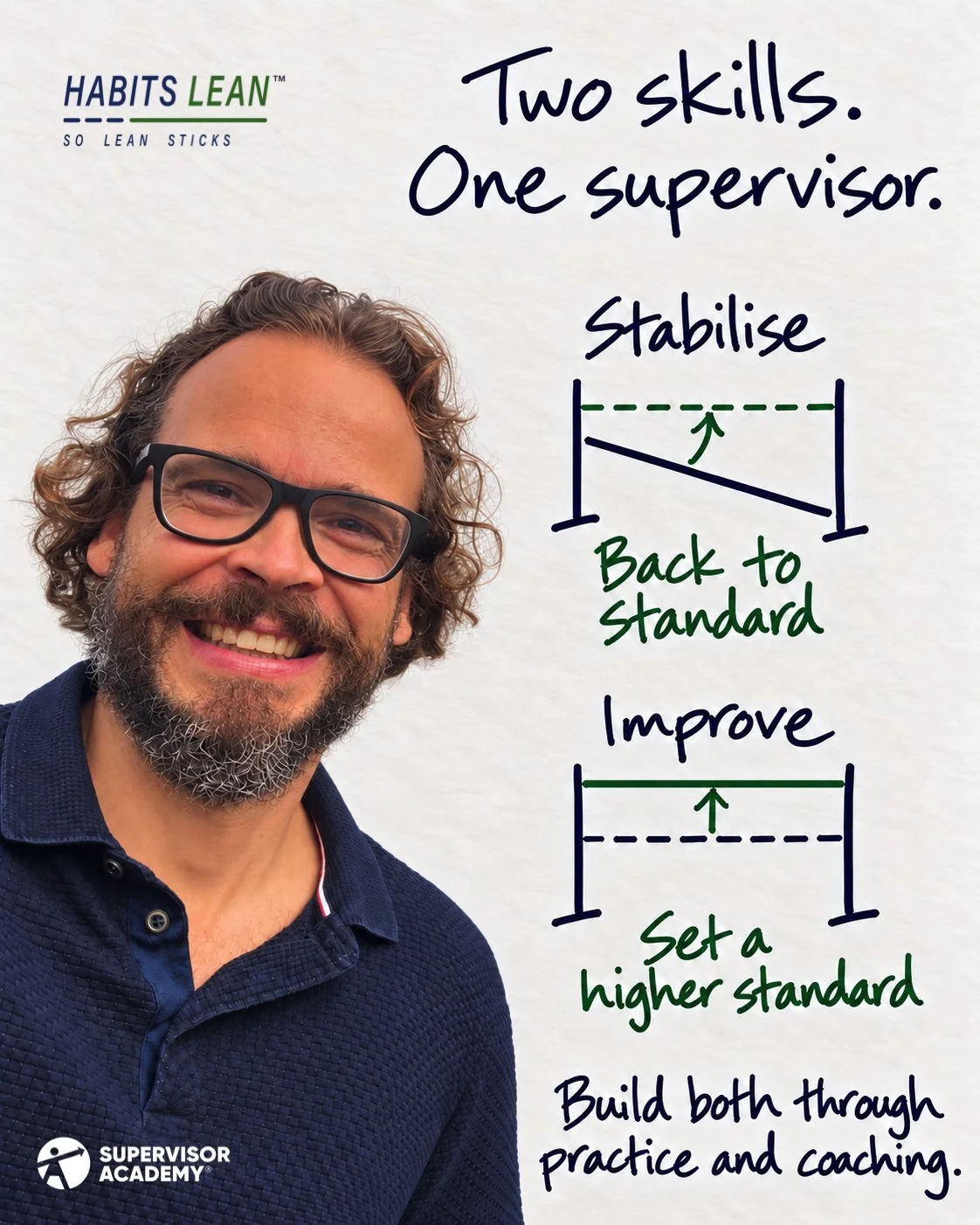
Supervisors need two complementary capabilities: stabilise (close caused gaps), where performance falls below the current standard, and improve (close created gaps), where a higher target requires capability beyond what the current method reliably delivers.
This article explains why and how organisations can develop both capabilities to maintain today’s standard while developing tomorrow’s.
Executive summary
Highly effective supervisors stabilise by closing caused gaps through containment that restores performance and countermeasures that prevent recurrence. These skills are central to stabilisation capability.
They improve performance by closing created gaps through purposeful targets, method development and scientific experimentation.
To sustain performance and accelerate improvement, organisations must develop both capabilities through training, coached practice in real work and a supportive organisational environment.
What are caused gaps and created gaps?
Caused gaps arise when identifiable causes reduce performance below its usual, proven level. Restoring performance often involves clarifying the method, developing skill or addressing attitudes that affect how the work is done.
Created gaps arise when stretch targets challenge teams to perform beyond their proven capability. Closing them often involves developing better methods and testing new ideas.
Caused gap
Reference point: An established standard or expected operating condition.
Question: What is preventing standard performance?
Purpose: Restore proven method and stabilise performance.
Created gap
Reference point: A deliberately chosen target above current capability.
Question: How must the work change to achieve higher performance?
Purpose: Develop a better method and raise performance.
Although closing caused gaps may also involve experimentation and changes to the method, the aim is to restore the current method and the performance it has already demonstrated.
Closing caused gaps through containment and countermeasures
A caused gap needs two responses. Containment controls the immediate problem, isolates suspect output and restores safe, quality flow. Countermeasures address the causes to prevent recurrence. The supervisor investigates conditions such as the method, equipment, materials and skill, with technical support where needed.
At a Supervisor Academy client, a packing line frequently stopped because corrugated cardboard jammed in the folding unit. The team leader cleared each jam and reset the unit, but repeated stops and delays in responding kept performance below its usual level for several weeks.
The supervisor and team leader investigated and found that a newly assigned operator on the evening shift had not been fully trained to set the folding unit correctly. They developed a Job Instruction breakdown for the setting method and trained the operator using the TWI Job Instruction 4-Step Method.
This daily follow-through is explored further in leadership habits that hold the gains.
Closing created gaps through better methods and experiments
A created gap sets a target above the performance the process can currently deliver reliably. The purpose is to encourage and support the team in developing a dependable method that achieves the higher level.
At the same client, the packaging line normally ran 15% below the manufacturer’s rated speed because the team knew it operated more smoothly, with fewer interruptions, at that pace. The rated speed was higher than the performance the team could reliably sustain.
When additional customer orders arrived, the manufacturing director challenged the team to increase the line speed to meet demand without overtime.
The team leader and operators ran daily experiments, gradually increasing the pace and developing countermeasures for problems as they emerged. They refined the setting method, replaced worn parts and worked with maintenance to adjust machine parameters. The revised methods were incorporated into operator and maintenance training and maintenance schedules.
Raising the number on the board creates a gap. Developing and proving a better method closes it.
Nuggets from our Toyota Research on Lean Habits
Our Toyota research offers useful lessons about matching the response to the gap and developing people’s ability to close it.
Different problems need different responses. Drawing on his Toyota experience, Art Smalley distinguishes four problem types requiring different problem-solving skills. For supervisors, the lesson is to match the approach to the problem and develop the capabilities to restore, sustain and raise performance. [1]
Improvement requires skill in studying work. Toyota’s Isao Kato described the company’s use of TWI and extensive training in process, motion and time analysis. His account illustrates how Toyota develops practical skills to question, improve and teach working methods. [2]
Higher targets need coached learning. Mike Rother connects improvement with daily practice and coaching. In his foreword to Toyota Kata Culture, Jeffrey Liker explains how problem solving and on-the-job development support Toyota’s objectives. The leadership responsibility extends beyond setting targets to developing people’s ability to achieve them. [3]
Implications for leaders
Start by identifying the gap: is performance falling below what the method has reliably delivered, or must the team develop greater capability?
Where both gaps exist, treat immediate recovery and prevention (sustaining performance) and the challenge of achieving higher performance (improving performance) separately.
Senior leaders must develop their organisation’s ability to close both caused and created gaps. This requires training, coaching, protected time for improvement and access to technical support.
Build stabilisation capability first, so teams can hold the gains as they improve. Read more about why stabilisation capability comes first.
Two questions can make your organisation’s development needs concrete:
Which recurring problem needs better containment and follow-through to prevent recurrence?
Which higher target requires a better method, and who will coach the supervisor in developing it?
Developing the skills behind both capabilities
Habits Lean™ is Supervisor Academy’s approach to developing front-line leadership skills and habits, supported by the conditions that let people apply them.
Organisations can accelerate capability development through established, teachable methods:
To close caused gaps:
TWI Job Instruction develops consistent job-skills
TWI Job Relations builds trust and cooperation;
TWI Production Management develops daily problem detection, containment and follow-through;
TWI Job Safety develops hazard recognition, corrective action and prevention.
To close created gaps:
Toyota Kata develops scientific improvement through coached practice;
TWI Job Methods develops skill in improving how work is done.
Repeated application and coaching make the skills dependable.
The capabilities reinforce one another. For example, we can only judge a new method’s effect reliably when people apply it consistently. Kata experiments test whether a countermeasure works, while Job Instruction develops the skill for people to apply and sustain an improved method. Effective Kata experiments require stability.
Questions and answers
Can work on a created gap uncover caused gaps?
Yes. Pursuing a higher target can expose existing equipment faults, skill gaps or inconsistent materials. Addressing these problems can stabilise the process and raise performance, helping to close the created gap.
What if the current target has never been achieved reliably?
A target on a board is not evidence of a capable method. First establish what the process can reliably deliver: its proven capability. If the required performance exceeds that capability, treat it as a created gap: the method needs further development.
Can supervisors work on both types of gap?
Yes. Supervisors need both capabilities, developed through practice and coaching, with technical support where needed. Protect today’s operation while making time to develop tomorrow’s method. Once a higher standard is achieved, stabilisation helps sustain it.
Which capability needs to be strengthened in your operation: restoring performance, raising capability, or both?
Check out our LinkedIn Post on “Why leaders who stabilise & improve win ”
References
[1] Smalley, A. (2019). Standardize Your Problem-Solving Approach? Why One Size Does Not Fit All. Lean Enterprise Institute, 30 January.
[2] Smalley, A. (2006). Isao Kato Interview on Shigeo Shingo’s Influence on TPS. Lean Enterprise Institute, 17 July.
[3] Rother, M. and Aulinger, G. (2017). Toyota Kata Culture: Building Organizational Capability and Mindset through Kata Coaching. McGraw-Hill.