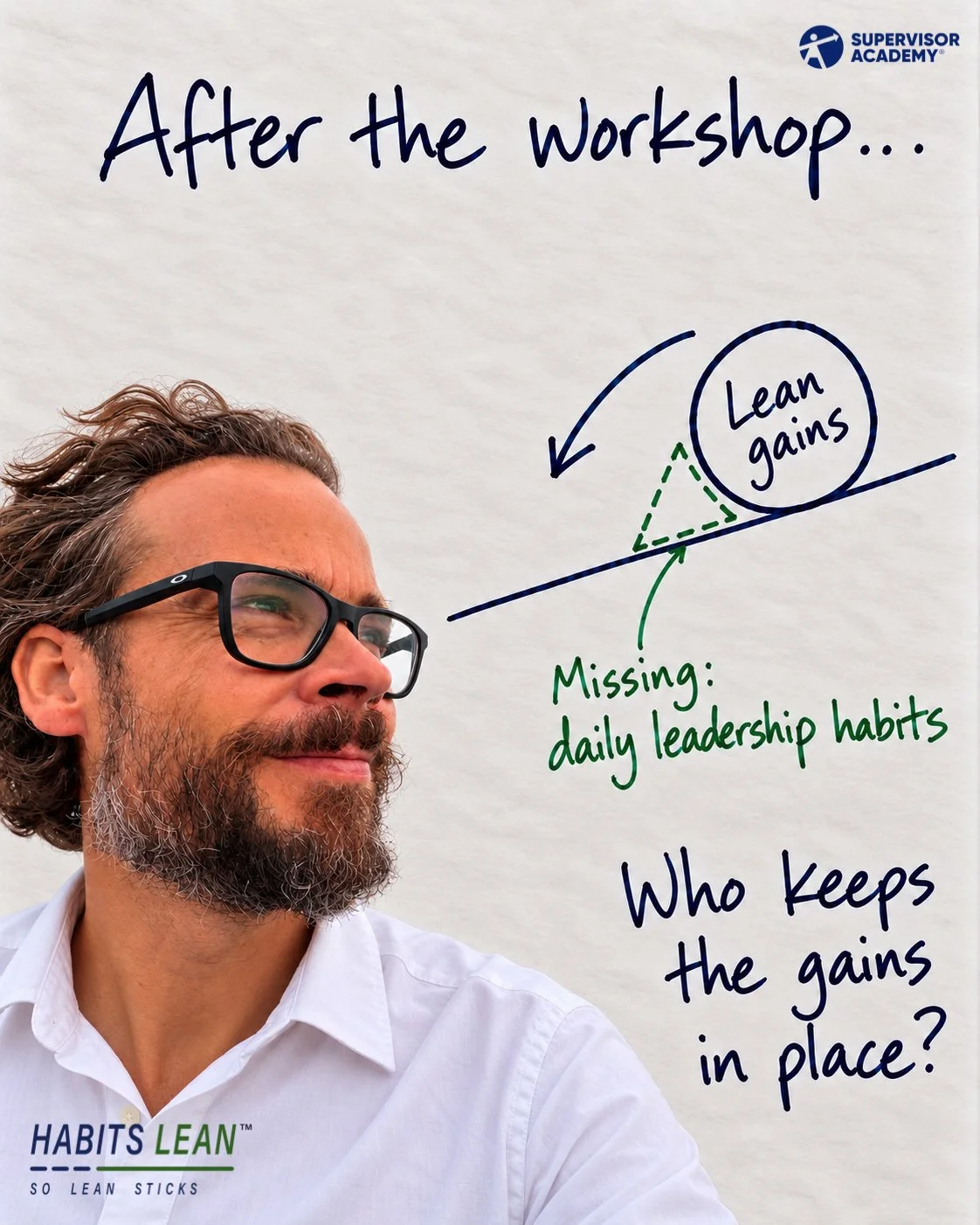
Organisations must build stabilisation capability first so later investment in improvement capability can deliver lasting returns. Otherwise, gains keep rolling back, slowing continuous improvement.
Stabilisation capability develops through front-line leaders’ skills and habits in three dimensions: teaching the best method consistently, making problems visible, and following through from containment to prevention.
These capabilities form the green wedge in the illustration, turning improvements into dependable daily work.
Executive summary
Stabilisation capability is the foundation for sustained improvement. Organisations must develop front-line leaders’ ability to:
Define and teach the best-known method so people can perform it correctly and consistently.
Make deviations and the appropriate containment response visible where the work happens.
Restore safety, quality and flow, then investigate causes and prevent recurrence.
What the stabilisation wedge represents
Every improvement should include a mechanism for sustaining the change and its gains. This is the stabilisation wedge that prevents gains from rolling back.
Creating an effective wedge requires stabilisation capability at the front line: the ability to establish dependable work, recognise departures from the expected condition, respond effectively and prevent recurring problems.
At Supervisor Academy, we use the wedge’s three corners to illustrate three core responsibilities of front-line leaders. Developing the skills and daily habits to fulfil these responsibilities builds stabilisation capability — the organisational muscle to preserve gains and establish a reliable starting point for further improvement.
Corner 1: Make the method clear and teach it consistently
The first responsibility is to define the best-known way to perform the work. The method must be clear enough to teach, including the important steps, the key points affecting safety, quality and flow, and the reasons for them.
At a Supervisor Academy client, an assembly team used Loctite to seal equipment, but frequent leaks at final test required disassembly, cleaning and resealing. This disrupted flow and required additional manpower to meet demand.
Internal experts recommended different application methods, so a Loctite engineer was invited to help the team establish the best approach. The supervisor then arranged for everyone to be trained in the agreed method. By observing the work and monitoring test results, he continued to refine both the method and the team’s skill in applying it.
Corner 2: Make deviations and the immediate response visible
People need to recognise departures from the method or expected condition in time to respond. The containment response must also be clear: what to do, who responds and when to call for help.
In the Loctite case, the team applied the Quality at the Source principle: don’t receive, don’t make, don’t pass on defects.
Don’t make: The operator checked their application against the key points and marked each checked location with a dot.
Don’t pass on: Before releasing the assembly, the operator visually verified that all required applications had been completed.
Don’t receive: The downstream operator visually checked all marked locations.
The visualisation was built into the work itself, giving the team a clear way to detect and signal problems and obtain support. A board reporting yesterday’s defects provides useful history, but does not trigger an immediate response.
Corner 3: Restore performance and prevent recurrence
When a problem occurs, contain it to protect quality and restore safe flow. This may require stopping work, isolating suspect output or obtaining supervisor or technical support. Restarting production must not allow the problem to pass downstream.
Containment alone is not enough. The supervisor must investigate and address the causes—related to the method, machines, materials, skill or another condition—to prevent recurrence.
In the Loctite case, immediate detection allowed the team to contain and the supervisor to investigate deviations where they occurred. Events were still fresh in operators’ minds, making the causes easier to determine.
If a countermeasure changes the method, return to the first corner of the triangle: update it, teach it and confirm performance. This loop is how the organisation learns and makes tomorrow better than today.
What weakens the stabilisation wedge
The three corners depend on one another. A documented method offers little protection if people have not learnt to perform it. Visual controls expose problems, but safety, quality and flow remain vulnerable without a response. Repeated containment keeps production moving while leaving the causes unresolved.
Leaders therefore need to connect standards, visual controls and problem-solving skills through daily management habits. Reinforcing standards, checking their effectiveness and improving them must become a natural part of everyday work.
Nuggets from our Toyota Research on Habits Lean
Our Toyota research illustrates how clear methods, visible problems and effective responses connect in practice, revealing the daily leadership habits needed to sustain improvements.
Steven Spear and H. Kent Bowen described Toyota’s work specifications as hypotheses tested through actual performance, with built-in checks that reveal departures from expected results. [1]
For leaders, this makes the standard a basis for teaching, observation and learning. A signed training record alone cannot demonstrate consistent performance of the method.
Writing about NUMMI, John Shook described how workers could signal difficulties with standardised work and receive prompt help from a team leader, connecting problem visibility with dependable management support. [2]
The leadership habit is to maintain that connection: notice the deviation, respond as agreed and support the person raising it. A signal that repeatedly produces no help leaves the process exposed and weakens team trust and commitment.
Toyota’s description of jidoka links detecting abnormalities, preventing defective output and preventing recurrence. [3] For supervisors, we draw a practical lesson: recovery and prevention belong within the same responsibility, even when specialist support may be needed.
Implications for leaders
Operational leaders need to own these responsibilities after the improvement event ends. Lean and engineering specialists can support development, but daily instruction, containment, countermeasures and follow-through must be part of how the operation is managed.
To develop stabilisation capability, senior leaders need to provide training, time, coaching and access to support. Front-line leaders develop the necessary skills and habits through real work and coached application.
Three questions can help focus leaders on a practical starting point:
Can people on each shift demonstrate the agreed method consistently?
When a deviation appears, is the response clear and reliably available?
Which problems keep returning despite repeated intervention?
Developing the skills behind these habits
Habits Lean™ is Supervisor Academy’s approach to developing front-line leadership capability and the organisational conditions that support it. Here, the focus is on habits that strengthen stabilisation and accelerate improvement.
Training Within Industry (TWI) provides a practical starting point, as it did for Toyota, by making foundational leadership skills teachable and coachable.
TWI Job Instruction develops supervisors’ ability to teach the method, building people’s skill in applying it. TWI Job Relations builds people’s will to follow it faithfully through trust and cooperation.
Visual management and TWI Problem Solving help leaders make problems visible, contain them and prevent recurrence.
Repeated application and coaching turn these skills into dependable leadership habits.
Questions and answers
What should supervisors do after a new method is introduced?
Teach it consistently, observe people to confirm correct application and monitor performance. Make deviations and required responses clear, then investigate and address the causes of the deviations.
What is the difference between containment and preventing recurrence?
Containment controls the immediate problem and protects safety, quality and flow. Prevention addresses its causes. Both are necessary to sustain the improved operating condition.
Who owns sustaining improvements after a Kaizen workshop?
Operational leaders own sustained performance. Supervisors and team leaders carry out daily stabilisation habits, with support from senior leaders, CI specialists and technical functions when problems exceed their ability or authority.
Build the capability to hold your gains — When an improvement slips back in your operation, which corner of the wedge needs attention?
Check out our LinkedIn Post about the “Stabilisation Wedge”
References
[1] Bowen, H. K. and Spear, S. (1999). Decoding the DNA of the Toyota Production System. Harvard Business School Working Knowledge, 12 October.
[2] Shook, J. (2010). How to Change a Culture: Lessons From NUMMI. MIT Sloan Management Review, 51(2).
[3] Toyota Motor Corporation. Toyota Production System. Jidoka section.