Lean doesn’t stick when organisations put improvement ahead of the capability to stabilise their work.
A Lean rollout can put substantial effort into workshops, Lean tools training and projects while giving too little attention to sustaining the changes. A better method may be introduced, but daily performance continues to fluctuate. The same problems return. Supervisors keep stepping in to recover the situation.
Sustaining Lean improvements requires a different priority: build the capability to stabilise first.
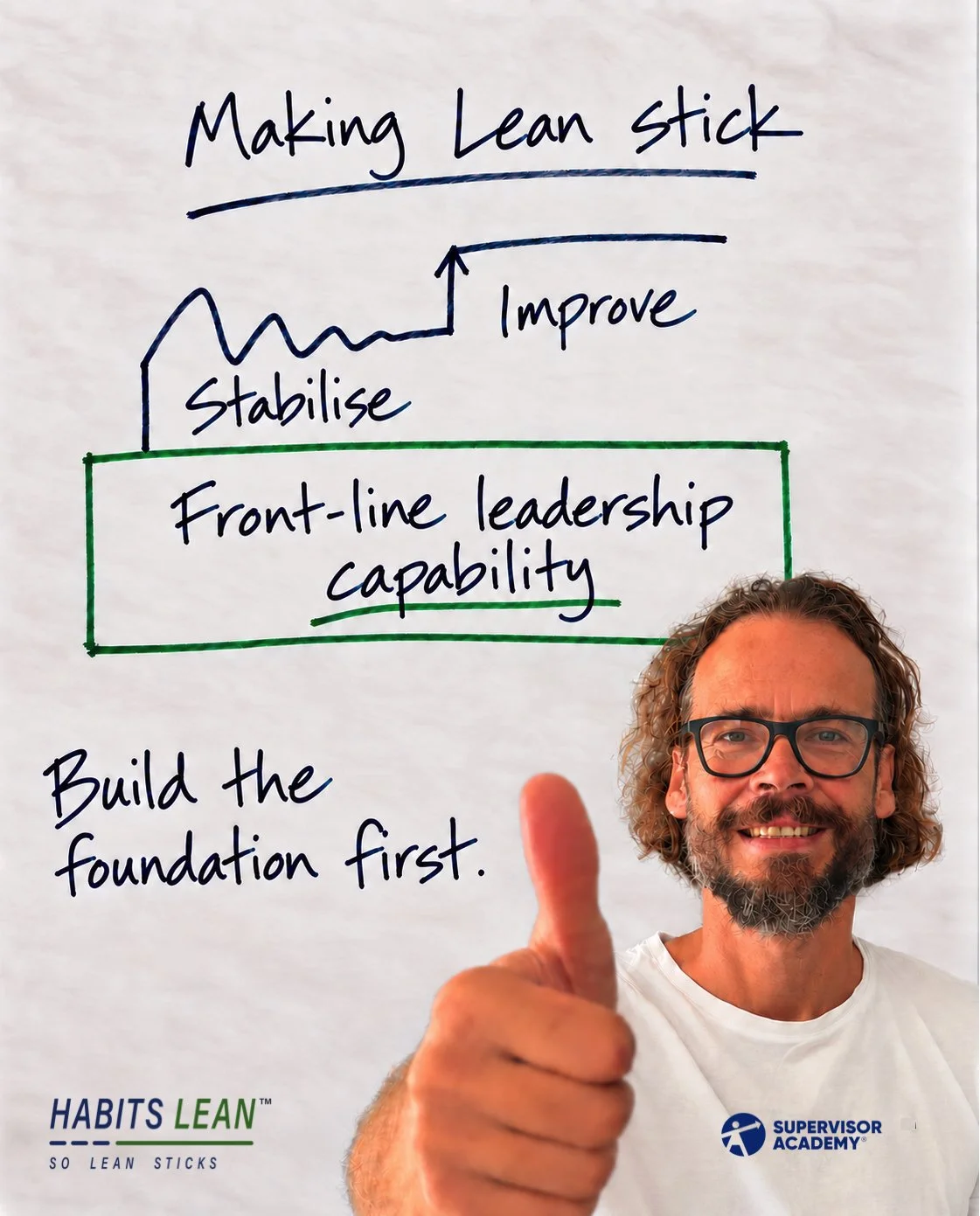
Stabilise first, then improve — stabilise again: squeeze variability before raising performance and stabilising again.
Executive summary
Improvement gains remain fragile when an organisation cannot stabilise daily work.
Organisations ultimately need both capabilities: stabilising performance and improving it. Prioritise stabilisation capability first.
Leaders must invest in front-line skills, dependable habits and the capacity to develop and apply them.
Why Lean improvements don’t last
The fluctuating line in the illustration represents unstable performance. Work and results vary between people and shifts. Problems interrupt the flow, and performance depends on repeated intervention.
As the organisation develops its capability to stabilise processes, variation reduces and dependable performance becomes easier to maintain.
The upward arrow represents improvement to a higher level, which must itself be stabilised.
When a Lean initiative concentrates on that upward arrow, it often overlooks the capability needed to hold the gains. Yet without building that capability first, each improvement remains vulnerable to the instability that undermined the previous one. Results keep slipping back.
This means that the foundational stabilisation capability is missing. Without it, Lean gains won't stick.
Reverse the rollout priority
For an organisation that has not yet learnt to stabilise, the rollout priority should therefore be reversed. First develop the capability to establish and sustain reliable performance, then build the capability to raise performance through improved methods.
Stabilisation capability means being able to develop people and processes, respond effectively to abnormalities and prevent those abnormalities from recurring.
It creates the conditions for an agreed method to be performed consistently and become the new baseline.
Ultimately, organisations need to be ambidextrous, able to perform two complementary jobs:
Stabilise: establish dependable work, respond when performance deviates and address the causes of recurring problems.
Improve: develop better ways of working to raise performance.
Both capabilities matter. However, for successive improvements to accumulate, an organisation must learn how to hold each gain.
The foundation is built at the front-line
The capability to stabilise work depends on what supervisors, team leaders and their teams do every day.
Front-line leaders must be able to establish reliable methods, teach them, recognise abnormalities and follow them through to resolution. Standardised-work implementation depends on those methods becoming dependable practice across shifts.
Achieving that consistency requires strong front-line leadership skills and habits. Clear methods give leaders specific behaviours to practise. Training within Industry - including TWI Job Instruction and TWI Job Relations, which have played a key role at Toyota since the 1950s - make these stabilisation methods teachable and coachable. [1] Coaching provides feedback so front-line leaders can refine their application and become more capable.
Toyota deliberately develops front-line leaders’ ability to manage standard operations and respond to abnormalities, combining training with coached workplace application, evaluation and feedback. [2] This highlights the importance of deliberately developing stabilisation capability and prioritising it in organisations that struggle to sustain gains.
Leaders must invest in capacity to develop capability
Front-line leaders need capacity both to develop these skills and to use them. A supervisor continually covering vacancies or dealing with material shortages has little opportunity to practise instruction, coach an operator or investigate a recurring problem.
Senior leaders must make room for that work. This means investing in development, providing capable coaches and protecting time for practice and follow-through. It also means examining whether workloads, spans of control and access to support allow supervisors to apply what they have learnt.
Without that capacity, training may introduce useful leadership methods while daily working conditions prevent the organisation from benefiting from them.
Building the foundation is a leadership investment. It belongs in the Lean rollout strategy from the outset.
Two questions can make that investment concrete:
Which recurring problem exposes a gap in your organisation's front-line capability?
What time, coaching and support are you as a leader willing to commit to developing and applying that capability?
Habits Lean™ is the Supervisor Academy approach to developing these front-line leadership capabilities and the organisational conditions that support them. It connects clear methods, daily application and coached practice so organisations can build the ability to stabilise first, then improve.
Questions and answers
Does stabilising first mean postponing improvement?
No. In practice, stabilising and improving go hand in hand. Focusing on stabilisation—catching disruptions to quality and flow and preventing their recurrence—creates a substantial uplift in performance. The resulting process and leadership capabilities strengthen subsequent efforts to raise performance further.
How is stabilisation different from daily firefighting?
Firefighting is a reactive intervention by a supervisor or team leader to contain a problem without addressing its causes. Problems recur, trapping the supervisor in a cycle of correcting the same problems. Stabilisation goes further: it develops the people, methods and operating conditions needed to remove those causes and prevent recurrence.
Can supervisor training alone make Lean improvements stick?
Training introduces methods. Supervisors also need coached practice, the capacity to apply those methods consistently and a supportive organisational environment. Senior leaders must provide these conditions for the organisation to benefit from the skills being developed.
Before asking for the next improvement, have you built the capability to sustain it?
Explore what process stability requires, or
Discuss your organisation’s capability challenge with Supervisor Academy.
References
[1] Toyota Motor Corporation. Developments in Education, 75 Years of Toyota. TWI Job Relations introduced in 1951; TWI Job Instruction in 1952.
[2] Toyota Motor Corporation. Sustainability Data Book 2018, Human Resources Development.