How to Build Process Stability in Manufacturing
Why do supervisors spend so much of the day reacting to problems that should have been detected earlier? Why do the same problems recur, day after day?
Most operational problems are not invisible. They begin as small deviations in the work:
A machine setting drifts.
Material arrives in the wrong quantity or location.
A quality check is missed.
The agreed method is no longer followed.
An operator encounters a condition they have not been trained to handle.
The deviation is not recognised quickly enough, so the process continues.
By the time the problem is noticed, it has already affected safety, quality or output — and the supervisor is pulled into firefighting.
If this sounds like your operation, there is a gap in your operating system.
Process stability in manufacturing means maintaining safe, consistent and predictable operating conditions while recognising and responding quickly when the actual condition moves away from the standard. It depends on three connected elements: clear Work Standards, effective visual controls and leadership routines that check conditions and respond to abnormalities.
This is the Stabilisation Triangle.
A stable process requires us to do three things:
Set the Work Standard.
Make problems visible.
Check and respond to abnormalities.
Systems drive behaviours. But to do that effectively, the system needs all three corners of the triangle.
A Work Standard without visual controls allows abnormalities to remain hidden.
Visual controls without a clear standard cannot reliably distinguish normal from abnormal.
Neither creates process stability in manufacturing without leadership routines that check the signals and respond when the actual condition moves away from the standard.
Why process stability in manufacturing breaks down
An unstable manufacturing process does not always look chaotic. The operation may still produce output. People may still complete the work. Supervisors may still meet the plan.
But beneath the surface, performance depends on repeated intervention, workarounds and supervisor firefighting.
Small abnormalities are tolerated or missed. People compensate for gaps in the operating system. Supervisors step in to protect the customer and to compensate for weaknesses in process or team performance.
The immediate problem may be contained, but the condition that allowed it to occur remains.
Over time, this creates recurring problems, variable performance and increasing dependence on supervisor intervention.
Process stability in manufacturing requires more than correcting problems after they have affected results. It requires a system that defines normal, exposes abnormal conditions and ensures that those signals lead to action.
The Stabilisation Triangle provides a practical way to build that system.
The Stabilisation Triangle
The three elements of the Stabilisation Triangle work together:
The Work Standard defines normal.
Visual controls expose abnormal.
Check-and-Respond Routines ensure that the signal leads to action.
Remove any one element and the cycle begins to break down.
Sustainable process stability depends on all three.
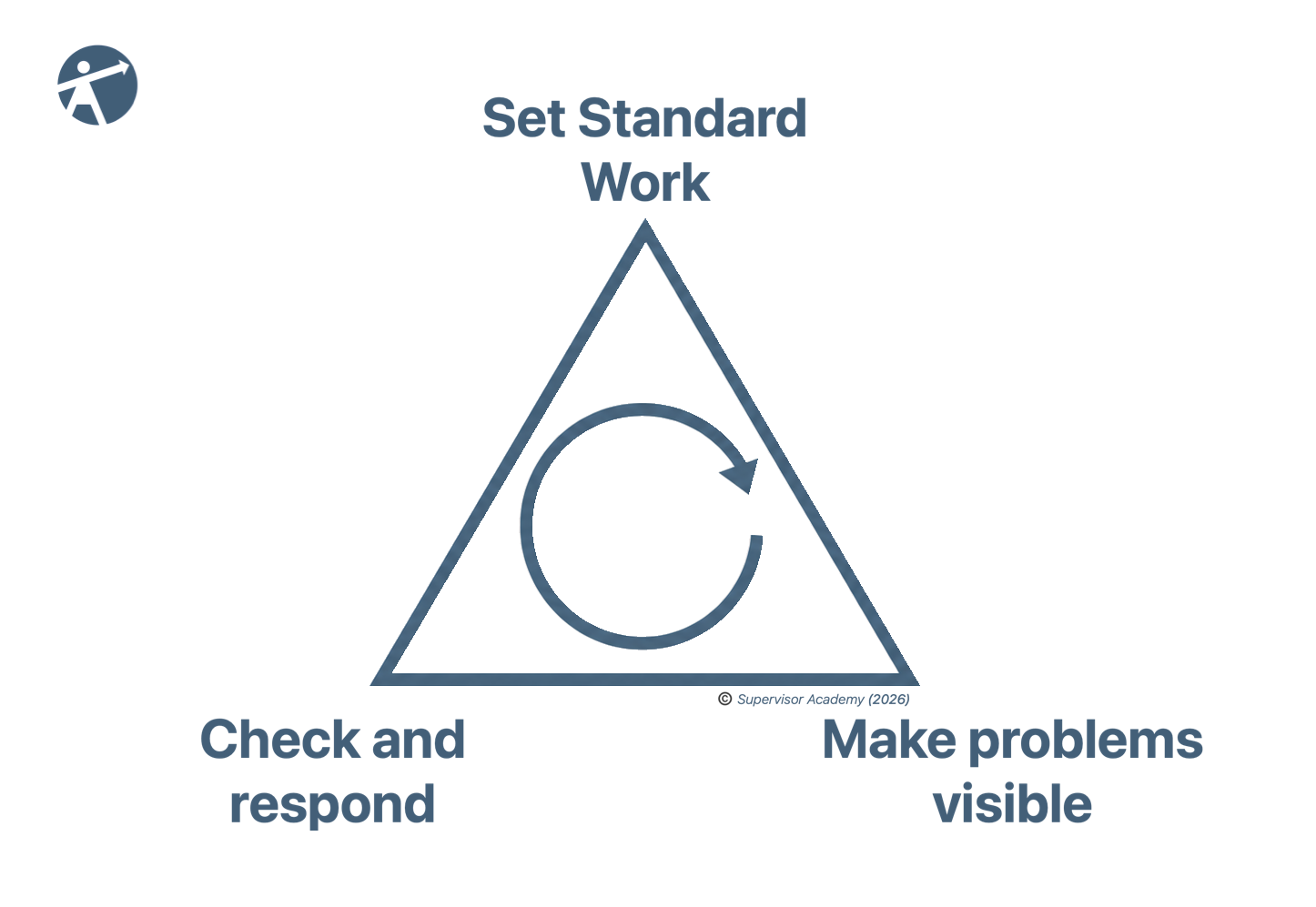
Lean management’s standard work triangle: set standard work, make problems visible, check and respond to support continuous improvement.
1. Set the Work Standard or Standard Operation
Work Standards provide the reference point for stabilisation.
They clarify the difference between:
What should be happening.
What is actually happening.
Without that reference point, it is difficult to recognise when a problem has occurred or determine what response is needed.
The first level of standardisation is to establish Work Standards or Standard Operations that are:
Easy to train and learn.
Easy to do.
Easy to check.
A Work Standard defines how the job should be done to achieve safety and quality. It includes the Important Steps and the safety and quality Key Points.
A Standard Operation defines the sequence in which tasks need to be carried out by the operator and a what pace.
The purpose of both types of standard work — Work Standard and Standard Operation — is not simply to tell people what to do.
It gives the team and supervisor a basis for identifying where the process is unstable.
TWI Job Instruction and Standard Work
TWI Job Instruction helps turn the Standard Work into a method that can be trained consistently.
The supervisor identifies the Important Steps, Key Points and Reasons, then teaches the work using the TWI Job Instruction 4-Step Method.
This helps ensure that people understand:
what to do;
how to do it;
why that particular way of doing the work matters;
what conditions must be maintained;
how to recognise and respond when those conditions are no longer present.
This is a critical connection between TWI Job Instruction and the implementation of standard work — whether it is to teach the operator how to do a task safely and correctly (Work Standard) or how to perform tasks in sequence and at the right pace (Standard Operation, also known as Standardised Work).
You don’t have Standard Work until you have standard behaviours.
A document alone does not create standard behaviour. To build standard behaviour, work must be broken down properly, taught consistently and confirmed at the workplace.
But all types of Standard Work must do more than support training.
They must also make it easy for the person doing the job, and the supervisor supporting them, to recognise when the actual condition has moved away from the standard.
2. Use visual controls to make problems visible
Once the expected condition has been defined, the next task is to make deviations easy to see.
Visual controls show the actual condition at a glance: normal or abnormal.
A good visual control positions the signal close to the work. It allows the people doing the job to notice that something has moved away from the standard before the deviation becomes a defect, delay or safety hazard.
Can your operators, team leaders and supervisors quickly see whether the correct method, quantity, location, timing or equipment condition is present?
When abnormalities are hidden inside paperwork, computer systems or monthly performance reports, the response will always come late.
Visual controls in manufacturing should help people answer practical questions immediately:
Is a person exposed to safety hazards?
Is the correct material in the right quantity available in the correct location?
Is the machine operating within the required condition?
Is the agreed method being followed?
Is production keeping pace with demand?
Has a quality condition changed?
Does somebody need to respond?
The purpose is to make the condition of the work easier to understand.
Detect abnormalities close to the work
The aim is not to make supervisors responsible for finding every problem or to police the people.
Relying entirely on front-line leaders to detect and fix problems traps the operation in a perpetual containment and supervisor firefighting loop.
It frustrates both the team and its supervisors, while the underlying causes remain unresolved.
Instead, the supervisor’s objective is to build a process that can detect and correct abnormalities as close to the work as possible, with progressively less dependence on supervisor intervention.
In essence, this means building a self-detecting and self-correcting process.
That requires training operators not only in how to perform the job, but also in:
how to use the visual controls;
how to recognise an abnormal condition;
what immediate action to take;
when the problem must be escalated.
TWI Job Instruction is a powerful method the supervisor can use to pass on and lock in this know-how.
TWI Job Relations enables the supervisor to keep the team aligned, involved and motivated as new standards and visual controls are introduced.
Empowering the team in this way is a critical part of the standardisation system.
3. Use Leader Standard Work to check and respond
The stabilisation system is built and maintained by supervisors, with the support of their leaders.
But is it working as intended?
What adjustments are needed to help the team and process perform more reliably?
These questions are answered through Leader Standard Work.
A key part of Leader Standard Work is the use of Check-and-Respond Routines.
Supervisors perform regular checks throughout the shift to confirm that:
people are fully skilled to do the work safely, correctly and consistently;
the agreed methods are being followed;
materials are available and correctly presented;
machines are set and operating as required;
quality checks are being completed effectively;
abnormalities are being recognised and acted upon.
These routines are not audits carried out at a distance from the work.
They are practical leadership habits that keep the supervisor connected to the actual condition.
Check-and-Respond Routines are also an essential part of daily production management. They help the supervisor detect emerging problems while they are still recent, visible and easier to understand.
The purpose is not simply to check whether people are complying.
The purpose is to understand whether the operating system is helping people perform successfully.
Containment and countermeasure are different responses
An abnormal signal should lead to two levels of response.
First response: containment
The immediate priority is to:
Protect people.
Protect the customer.
Protect the pace of work.
Restore the standard.
Containment prevents the situation from getting worse.
It protects the operation today.
Second response: countermeasure
The next step is to understand what allowed the abnormality to occur and adjust the operating system to prevent recurrence.
This means asking:
Why was the condition not prevented?
Why was it not detected earlier?
Why did the expected response not happen?
What needs to change in the Work Standard?
Does the visual control need to improve?
Was the work trained properly?
Does the Check-and-Respond Routine need to change?
The countermeasure strengthens the operating system.
It reduces the likelihood that the same problem will return tomorrow.
Confusing containment with countermeasure is one of the reasons supervisor firefighting becomes permanent. The operation responds, restores output and then moves on without changing the condition that allowed the problem to occur.
A process-stability example from the shop floor
Problem
A visual control shows that a component on the line is running low.
If the problem is not addressed within the next 20 minutes, the line will stop — or people may introduce workarounds that break the Standard Operation.
Check
During a routine check on the line, the supervisor detects the problem.
It should already have been identified by the material handler during their regular rounds, so something in the system has not worked as intended.
Respond — containment
The supervisor protects output by arranging urgent replenishment from the stores.
This prevents an immediate line stop and restores the flow.
Respond — countermeasure
The line supervisor and shop-floor supervisor investigate the problem with the lead operators and manufacturing engineer.
Because the problem is recent, the cause can be traced more easily.
Several defective components had been detected, increasing component consumption.
The defective components were correctly taken off-line, but the replenishment system did not replace them.
The team then studied the inventory-control and replacement process in more detail, with the aim of building an improved and more automatic response into the Standard Work.
This distinction matters.
The urgent replenishment prevents the line from stopping today.
The countermeasure improves the system so that the same problem is less likely to return tomorrow.
How TWI Production Management builds process stability
In our clients’ organisations, we use the TWI Production Management programme to help front-line leaders and managers build process stability in manufacturing.
The method gives supervisors a practical routine for investigating variation, responding to abnormalities and strengthening Standard Work:
Step 1 – Observe the Work
Contain Problem, If Needed
Step 2 – Understand the Problem
Step 3 – Develop Countermeasure
Step 4 – Put Countermeasure to Work
After observing the work, the supervisor contains any immediate safety, quality or flow risk. This may include protecting the person, stopping bad products, checking for downstream defects and restoring the flow. The purpose is to protect the customer and stop the immediate problem from getting worse.
The supervisor then agrees the facts, understands the problem and selects the correct Solution Course to develop a countermeasure. Depending on the condition, this may involve writing a Work Instruction, improving the method (TWI Job Methods), developing skill (TWI Job Instruction), or correcting attitudes (TWI Job Relations). For safety-related problems, the supervisor applies TWI Job Safety.
The final step is to put the countermeasure to work, observe and coach, and watch for recurrence. The method is then repeated to stabilise Standard Work.
This is how TWI Production Management supports daily production management and process stability in manufacturing. It connects observation, containment, problem understanding, countermeasure development and follow-up into one practical supervisory routine.
From supervisor firefighting to stable performance
The TWI Production Management training builds understanding of these routines. Repeated shop-floor practice develops the skill and helps establish new leadership habits.
Over time, the supervisor becomes less dependent on firefighting and more focused on creating the conditions for stable performance.
Instead of repeatedly stepping in to fix the same problem, the supervisor learns to:
observe the actual work;
identify variation and slowdown;
contain immediate risks;
understand the facts;
select the correct solution course;
develops and implements the countermeasure;
confirms its effectiveness.
The result is a system that recognises abnormalities sooner, responds more effectively and learns from them.
Three corners make a system
Sustainable process stability in manufacturing does not come from one tool.
It comes from connecting three elements:
The Work Standard defines normal.
Visual controls expose abnormal.
Check-and-Respond Routines ensure that the signal leads to action.
Sustainable standardised work depends on the standard being clear, visible, trained consistently and reinforced through daily leadership routines. Remove any one corner of the Stabilisation Triangle and the cycle begins to break down.
That is how process stability in manufacturing is built. Three corners make a system that drives behaviours.
This stabilisation system builds on powerful TWI leadership skills:
TWI Job Instruction helps supervisors train the Standard Work consistently.
TWI Job Relations gets and keeps the team on board with the changes.
TWI Production Management develops the skills that stabilise the Standard Work.
By building these approaches into Leader Standard Work, we create habits that keep the system active at the workplace.
Frequently asked questions
What is process stability in manufacturing?
Process stability in manufacturing means maintaining safe, predictable and repeatable operating conditions while detecting and responding quickly when actual performance moves away from the standard.
How do visual controls improve process stability?
Visual controls make the actual condition visible close to the work. They help operators and supervisors distinguish normal from abnormal before a deviation becomes a safety, quality or output problem.
What is the role of Leader Standard Work?
Leader Standard Work establishes the regular Check-and-Respond Routines supervisors use to confirm that standards are understood, followed and producing the expected condition.
How does TWI Production Management reduce firefighting?
TWI Production Management develops the skills required to stabilise process performance. Supervisors observe the work, contain immediate risks, understand problems, develop countermeasures and confirm that improvements have stabilised Standard Work.
Which corner creates the greatest gap?
Which corner of the Stabilisation Triangle creates the greatest gap in your operation today?
Are your supervisors spending too much time firefighting?
Explore how TWI Production Management develops the practical routines needed to stabilise performance.